Here to help: 0161 518 0825 | info@gofirstaid.co.uk
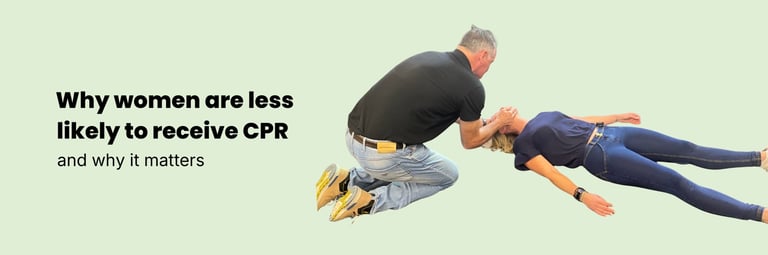
Women and CPR
Why we need to talk about Gender in cardiac arrest.
Gemma Johnson-Davies
6/4/20264 min read
If someone collapsed in front of you, would you act?
Imagine you’re at work, in a café, at the gym, or out with friends.
Someone suddenly collapses.
They are unresponsive.
They are not breathing normally.
You recognise they need CPR.
The casualty is a women, does that make a difference to your actions?
Research suggests there are barriers that can make bystanders hesitate, and that hesitation can affect whether someone receives lifesaving CPR quickly.
Cardiac arrest can happen to anyone
Cardiac arrest does not care about someone’s age, fitness level, or lifestyle. It can happen anywhere:
At home
At work
In public places
During everyday activities
In the UK, there are around 115,000 out-of-hospital cardiac arrests reported to ambulance services each year, with ambulance services attempting resuscitation in around 43,000 people.
When someone has a cardiac arrest, every minute matters.
CPR helps keep blood and oxygen moving around the body, while an AED can help restore a normal heart rhythm when appropriate.
Are women less likely to receive CPR?
Research has shown that women experiencing cardiac arrest can face differences in the care they receive.
Studies have found that women are less likely than men to receive bystander CPR and defibrillation in some situations.
The reasons are complex, but one factor researchers have explored is confidence and hesitation from members of the public.
Some people worry about:
Touching a woman’s chest
Removing clothing if an AED is needed
Doing something wrong
But during a cardiac emergency, the priority is simple:
Someone who is not breathing or not breathing normally needs CPR.
They need someone to act.
CPR is exactly the same for women and men
There is a common misconception that CPR is different depending on who needs help. It isn’t.
The steps are the same:
Check for a response
Call 999
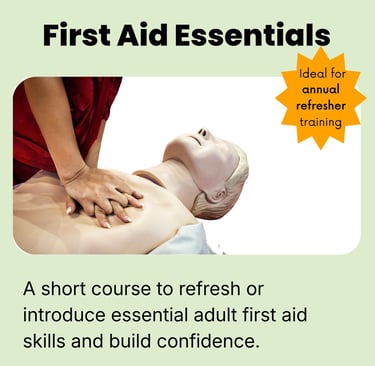
Start chest compressions
Use an AED as soon as possible
The aim is not perfection.
The aim is to keep someone alive until professional help arrives.
What about bras and AEDs?
This is one of the most common questions people ask in first aid training, and it’s a really important one to address properly, because uncertainty here can lead to hesitation in a real emergency.
Recent UK-focused discussion and evidence reviews (including work referenced alongside resuscitation guidance updates) have looked at whether clothing, including bras, can delay or interfere with correct AED pad placement during a cardiac arrest.
The key point is simple:
Nothing about clothing should delay CPR or the use of an AED.
When someone is in cardiac arrest, time is critical. The priority is always to start chest compressions immediately and get an AED onto the person as quickly as possible.
AED pads must go directly on the skin
For an AED to work effectively, the pads need to stick firmly to bare skin so the device can analyse the heart rhythm and deliver a shock if needed.
In practice, this means:
Clothing covering the chest must be moved out of the way
The chest must be exposed enough to place the pads correctly
Any barriers that prevent good pad contact need to be dealt with quickly
This is not about exposing the person unnecessarily; it is purely about allowing the AED to do its job.
So what about bras specifically?
In most situations, bras can simply be moved or opened enough to allow correct pad placement.
However, in some cases, particularly with certain bra types (for example, underwired bras or sports bras with rigid structures) they may interfere with where the pads need to go.
If that happens, the bra may need to be cut or removed to ensure the pads are placed correctly.
This is not something to overthink in the moment. AED kits are designed to support this, and first aid training teaches you to work quickly and safely without delay.
The most important rule
If you take only one thing from this section, it should be this:
Do not let clothing slow you down.
In a cardiac arrest:
Start CPR immediately
Send someone for an AED straight away
Follow the AED prompts as soon as it arrives
Every second without CPR or defibrillation reduces the chance of survival.
What UK guidance focuses on
The Resuscitation Council UK continues to emphasise in its most recent guidance that bystanders should be encouraged to act confidently in cardiac arrest situations, without unnecessary hesitation or fear of “doing the wrong thing”.
The message is consistent:
Start CPR. Use the AED. Do it quickly.
The equipment and guidance are designed to support ordinary people to save lives, not to create additional barriers or complexity in a moment where clarity matters most.
The takeaway
A woman experiencing cardiac arrest does not need someone to wait for the perfect moment.
She needs someone to act.
CPR is not about being a medical expert.
It is about having the confidence to step forward when someone needs help.
And that confidence can save a life.
Sources
Resuscitation Council UK 2025 Resuscitation Guidelines. Adult Basic Life Support and Epidemiology of Cardiac Arrest.
Resuscitation Plus (2025): Removal of bra for pad placement and defibrillation. A Scoping Review.



Ready to learn more?
Looking for first aid training in Greater Manchester? Get in touch with GO! First Aid and we'll help you find the right course or training option.
GO! First Aid
0161 5180825
info@gofirstaid.co.uk
First aid training across Greater Manchester
© 2026. All rights reserved. VAT No. 254490693



Home